
Screen-Free Money Lessons for Kids in the Roblox Generation
Ask a primary-school kid what money is and you might hear about coins, a tap-and-go card, or the currency inside their favourite game. Plenty of children now meet "money" first as a number on a screen: something you earn by playing and spend in a single tap.
That isn't a reason to panic. It is a good reason to give kids some money lessons they can actually hold: things to swap, count, wait for and colour in. This post shares easy, screen-free ideas you can run at the kitchen table this week, mostly with things you already have at home.
Why screen-free money lessons for kids matter now
Screens are a big part of childhood, and the shift is easy to see in Australia. Since December 2025, under the national social media minimum age law, major social media platforms must take reasonable steps to stop under-16s from holding accounts. Online games like Roblox aren't covered. (The Straits Times; Center Forward)
In a July 2026 Ipsos survey of Australian 13–15-year-olds who had used social media before the ban, 43% said they had spent more time playing video games since it began. Half (50%) said they were spending more time on Roblox. (Center Forward / Ipsos)
That survey is about teens, but the takeaway helps younger kids too. Games will keep teaching children something about money, so it's worth adding lessons where the value is physical, the waiting is real and a grown-up is there to talk it through.
1. Run a kitchen-table trading game
Trading is the oldest money lesson there is, and children are naturally good at it.
You'll need: a basket of small things (pegs, buttons, stickers, crackers, toy cars) and two or more players.
How to play:
- Give each player a different "stash". One gets stickers, another gets crackers.
- Let them trade freely for five minutes. No rules except "both people must agree".
- Afterwards, talk about it: Why did you want that? Was it a fair swap? What happened when someone didn't want what you had?
That last question is the big one. Kids quickly find out why people invented money: it's hard to trade stickers with someone who only wants crackers. Something everyone agrees to accept makes swapping much easier.
2. Make a waiting jar
Saving is really about waiting, and waiting is hard when you're six.
Grab a clear jar and choose a small, real goal together: a special treat, a book, a trip to the pool. Each time your child adds a coin or a token, they colour in one step on a paper tracker taped to the jar. Clear jars work best because kids can see the pile grow.
A ladder of ten boxes drawn on scrap paper makes a great tracker: colour one in each time something goes in the jar.
Talk about it: How did it feel to wait? Was it worth it? Celebrate the wait itself, not just the treat at the end.
3. Play the "only ten" scarcity game
Scarcity sounds like a grown-up word, but kids get it straight away when there are only ten of something.
- Make ten "special tokens" (cut-out paper circles, bottle caps or painted pebbles).
- Announce the rule: there will never be any more than ten.
- Use them for a week as the household currency for small privileges, like choosing the bedtime story or picking the dinner vegetable.
Partway through, ask: What would happen if I could make more tokens whenever I wanted? Would they still feel special? This one question opens a great conversation about why some money keeps its value and some doesn't. You don't need charts or prices, just ten tokens and a curious kid.
4. Practise sats maths on paper
Little units are great for little mathematicians. In Bitcoin, the smallest unit is called a "sat" (short for satoshi), and counting sats on paper is a fun way to practise addition and place value.
Try simple word problems:
- Bitcoin Guy has 5 sats and finds 3 more. How many now?
- A sticker costs 4 sats. You have 10. How many stickers can you buy, and what's left over?
Swap in real coins or counters for younger kids. Pencil, paper and no batteries.
5. Keep secrets safe with a family "secret words" promise
Here's a money lesson that's really a safety lesson. Some things should never be shared, whether it's a password, a PIN or a special phrase.
Make up a silly family code word together and practise the rule: we only share it with Mum, Dad or a trusted grown-up, never with a stranger, and never online. Kids who play online games will run into this idea sooner or later, so it helps to learn it at the kitchen table first.
Write the promise out together and let your child sign it.
6. Colour while you chat
Colouring is underrated as a conversation starter. With hands busy and no screen to look at, children often chat more freely, and that's your moment for an easy question: What would you save up for? What makes something valuable?
For toddlers and preschoolers, simple pictures work best. Bitcoin Guy – My First Bitcoin Coloring Book and Bitcoin Girl – My First Bitcoin Coloring Book are 20-page printables for ages 2–5, with big friendly drawings and lots of room for crayons.
Tips for keeping it fun
- Keep it short. Ten to fifteen minutes is plenty for young kids.
- Follow their questions. If they want to talk about why the jar is heavy, go with it.
- Use real objects. Coins, tokens and paper beat a screen for this age group.
- Skip the lectures. You're teaching ideas such as trading, waiting, scarcity and keeping secrets safe. You're not giving financial advice, and nobody needs a price chart.
- Repeat often. The trading game is just as good the fifth time.
A simple week to try
- Monday: kitchen-table trading game (15 min)
- Tuesday: set up the waiting jar (10 min)
- Wednesday: start the "only ten" token game (10 min)
- Thursday: sats maths word problems (15 min)
- Friday: family secret-words promise and colouring (20 min)
Grab a printable to make it easy
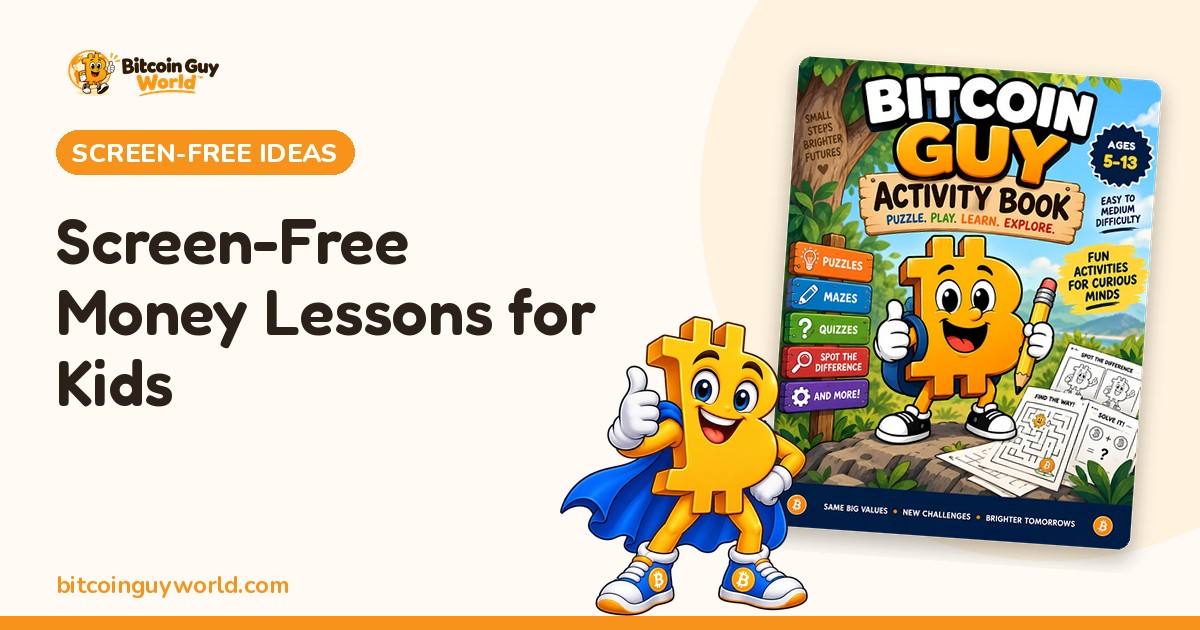
New: the Bitcoin Guy Activity Book, 40 printable pages of Bitcoin puzzles for ages 5–13 with Bitcoin Guy and Bitcoin Girl, including mazes, word finds, Sats Sums, two spot-the-difference scenes and a My Waiting Jar savings tracker. It is all puzzles and activities, with no colouring pages.
For colouring pages, the Bitcoin Guy Bundle (Vol. 1 + Vol. 2) covers toddlers through to older kids. Prefer to try before you buy? Grab the free activity pack from the homepage.